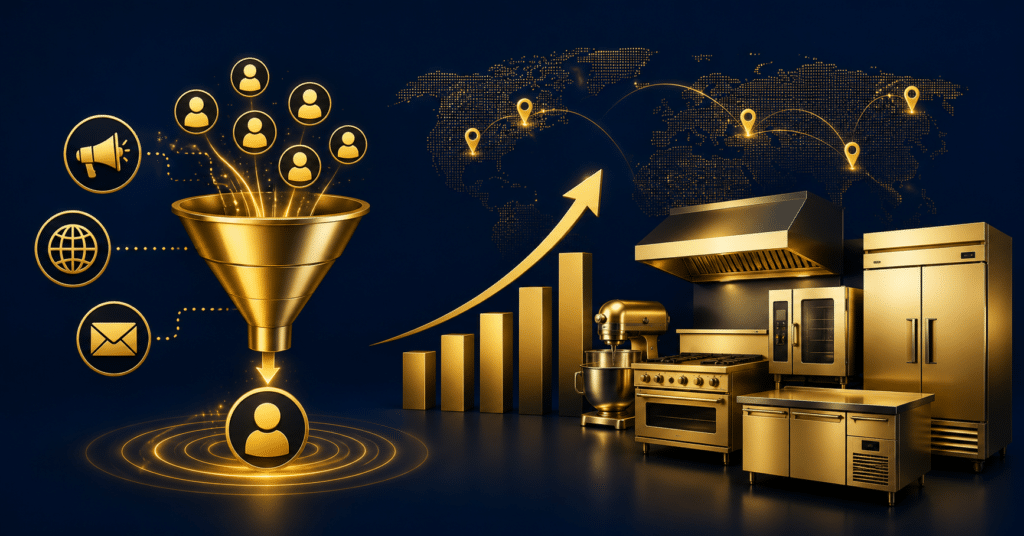
The kitchen equipment industry is busier than ever. Restaurants, hotels, cloud kitchens, catering companies, and institutional canteens are opening every month, and all of them need reliable, high-quality equipment. Yet many kitchen equipment manufacturers still struggle with one thing: finding enough of the right buyers at the right time.
You can build the best commercial ovens, refrigeration units, or steam cookers in the market, but if your sales team is not getting fresh, qualified enquiries every week, growth becomes slow and unpredictable. This is exactly why lead generation services have become so important for manufacturers in this space. In this blog, we will break down what lead generation really means for a kitchen equipment business, why old-school methods are no longer enough, and how a smart, modern approach can bring steady business growth.
Why Do Kitchen Equipment Manufacturers Need Lead Generation Services?
Most kitchen equipment manufacturers started their business through word of mouth, dealer networks, or trade exhibitions. These channels worked well for years, but the buying behaviour of customers has changed a lot. Today, a hotel owner or restaurant chain manager looking for commercial kitchen equipment starts their search on Google, not in a trade directory. They compare brands, read reviews, watch product videos, and shortlist two or three suppliers before ever picking up the phone.
If your business is not visible during this research stage, you simply do not exist for that buyer. This is where professional lead generation services step in. They help you appear in front of buyers exactly when they are searching, collect their details in a structured way, and pass on only the enquiries that are worth your sales team’s time.
Unlike random walk-in enquiries, a proper lead generation process brings a steady, measurable flow of interested buyers. Instead of hoping someone calls after seeing your exhibition stall, you build a system that works every single day, even while your team is sleeping.
Understanding the Buyer Journey in the Kitchen Equipment Industry
Before setting up any lead generation services, it helps to understand how a typical buyer thinks. A hotel project manager planning a new kitchen does not wake up one day and buy a fryer. There is a journey involved.
First, they realise they need equipment, maybe because of a new property launch or an upgrade. Second, they start researching brands, specifications, capacity, and pricing. Third, they compare two or three manufacturers based on quality, warranty, after-sales service, and price. Finally, they make contact and negotiate before placing the order.
A good lead generation strategy is built around this journey. It does not just try to grab attention once. It stays connected with the buyer at every stage, through website content, social proof, retargeting ads, and email follow-ups, so that when the buyer is finally ready to purchase, your brand is the first name that comes to mind.
Common Challenges Manufacturers Face Without Proper Lead Generation
Many kitchen equipment manufacturers rely only on their existing dealer network or a handful of long-term clients. This feels safe, but it is actually risky. If one big client moves to a competitor, sales can drop sharply. Without a proper lead generation system, businesses often face a few common problems.
The first problem is inconsistent enquiry flow. Some months bring plenty of orders, while other months are completely dry, making it hard to plan production or manage cash flow. The second problem is poor lead quality. Many manufacturers get calls from people who are just comparing prices with no real buying intent, which wastes the sales team’s time and energy. The third problem is limited market reach. A manufacturer based in one city may have excellent products but almost no visibility outside their local region, even though there is huge demand in other states or countries.
The fourth issue is dependence on trade shows and exhibitions, which are expensive and only happen a few times a year. Between two exhibitions, the sales pipeline can go quiet. The fifth problem is a weak digital presence. Many manufacturers have an outdated website or none at all, so even interested buyers cannot find enough information to trust the brand.
All of these challenges point to one solution: a structured, ongoing lead generation system rather than one-off efforts.
How Modern Lead Generation Works for Kitchen Equipment Brands
A strong lead generation strategy for this industry usually combines several digital channels working together, rather than depending on just one method. Search engine optimisation, commonly known as SEO, helps your website appear when buyers search for terms like commercial kitchen equipment suppliers or bulk cooking equipment manufacturers. Since these searches often come from people who are already looking to buy, SEO tends to bring some of the highest quality leads over time.
Paid advertising, such as Google Ads and social media ads, is another powerful channel. These campaigns can target hotel chains, catering businesses, restaurant owners, and even government tenders, based on their location, industry, and online behaviour. Paid ads work faster than SEO and are great for generating quick results while long-term organic strategies are being built.
Content marketing also plays a big role. Buyers in this industry often want detailed information before making a decision, so blogs, buying guides, comparison articles, and product videos help build trust. When a manufacturer regularly publishes useful content, it positions itself as an expert rather than just another seller.
Email and WhatsApp marketing help nurture leads who are not ready to buy immediately. A hotel project might be planned for six months later, so staying in touch with helpful updates, catalogues, and offers keeps your brand fresh in their mind until they are ready to place an order.
Finally, landing pages and lead capture forms are essential. Instead of sending every visitor to a generic homepage, smart campaigns direct them to a focused landing page built around one product category, with a simple form to request a quote or catalogue. This small change alone can double or triple the number of enquiries a website receives.
The Role of a Website in Lead Generation
Your website is often the very first impression a buyer gets of your brand, especially if they have never met your team in person. A slow, outdated, or confusing website can push potential buyers straight to a competitor, even if your products are actually better.
A website built for lead generation looks and works differently from a simple information website. It clearly displays product categories, technical specifications, certifications, and past project examples. It includes clear calls to action, like Request a Quote or Download Catalogue, on every page. It loads quickly on mobile phones, since many buyers, especially site engineers and project managers, browse on their phones while at a job site. It also includes trust signals such as client logos, testimonials, and case studies, which reassure a new buyer that your equipment is reliable.
When these elements come together, a website stops being just a digital brochure and becomes an active sales tool that works around the clock.
Why Quality Matters More Than Quantity in Leads
It is tempting to think that more leads always mean more business, but that is not always true. A manufacturer receiving five hundred low-quality leads a month may end up with fewer actual sales than one receiving fifty highly targeted leads. This is because unqualified leads waste the sales team’s time, lower their motivation, and often lead to frustration.
Good lead generation services focus on qualifying leads before they reach your sales team. This means checking whether the enquiry is from a genuine business buyer, understanding their budget and timeline, and confirming they have real purchase intent. When your sales team only speaks to serious buyers, their conversion rate improves, and they can close deals faster.
This shift from chasing quantity to focusing on quality is one of the biggest differences between old-fashioned marketing and a modern, results-driven lead generation approach.
Measuring Success: What Manufacturers Should Track
One of the biggest advantages of digital lead generation over traditional methods is that everything can be measured. A manufacturer should track metrics like the number of enquiries generated each month, the cost of acquiring each lead, the percentage of leads that convert into actual sales, and the average value of each order.
By reviewing these numbers regularly, a business can understand which channels are working best. Maybe Google Ads is bringing high-value hotel clients, while SEO is bringing smaller restaurant orders in larger numbers. With this data, budgets can be shifted toward the channels that give the best return, instead of guessing where to spend marketing money.
This kind of tracking also helps in forecasting. If a manufacturer knows that on average one out of every twenty leads becomes a paying customer, they can predict how many leads are needed each month to hit their sales targets, and plan marketing activity accordingly.
Building Trust in a Competitive Market
The kitchen equipment industry has many players, from small local workshops to large national brands. In such a crowded market, trust becomes a major deciding factor. Buyers want to know that if something goes wrong with their fryer or refrigeration unit during peak business hours, the manufacturer will respond quickly.
This is why lead generation strategies for this industry should always include trust-building elements. Sharing real client testimonials, showcasing completed hotel or restaurant projects, highlighting certifications and safety standards, and being transparent about warranty and service support all help a hesitant buyer feel confident enough to make contact.
A manufacturer that combines strong lead generation with clear trust signals will always perform better than one that focuses purely on advertising spend without building credibility.
The Role of Social Media in Reaching Hospitality Buyers
Social media is often underestimated by manufacturers, but platforms like Instagram, Facebook, and LinkedIn have become useful tools for reaching hospitality buyers. Instagram and Facebook work well for showing your equipment in action through short videos, behind-the-scenes factory footage, and finished kitchen setups at hotels or restaurants. Visual proof of quality builds interest quickly, especially among younger restaurant owners and cloud kitchen founders who scroll through these platforms daily.
LinkedIn, on the other hand, is more useful for reaching decision-makers at hotel chains, catering companies, and institutional buyers such as hospitals or corporate cafeterias. Sharing case studies, project completions, and industry insights on LinkedIn helps position your brand as a serious, established player rather than a small local unit. Many large hospitality projects begin with a simple LinkedIn message or comment before moving to a formal enquiry.
Combining social media visibility with your website and paid campaigns creates multiple touchpoints, so a buyer sees your brand consistently across different platforms, which naturally builds familiarity and trust over time.
Why Local and Regional Targeting Still Matters
While digital marketing opens the door to national and even international buyers, local and regional targeting remains extremely important for kitchen equipment manufacturers. Many buyers still prefer suppliers who are geographically closer, since installation, servicing, and spare parts become easier to manage. A well-planned lead generation strategy should include location-based targeting, so your ads and content reach buyers in cities and regions where you can offer strong after-sales support.
This is especially useful for manufacturers expanding into new territories. Instead of blindly advertising everywhere, a consultant can help identify high-potential regions based on hotel and restaurant growth data, competitor presence, and existing customer clusters, ensuring marketing budgets are spent where they will bring the best results.
Handling Long Sales Cycles Without Losing Leads
One unique challenge in the kitchen equipment industry is the length of the sales cycle. A hotel project might take six months to a year from planning to actual purchase. Many manufacturers lose potential customers simply because they stop following up too early, assuming silence means disinterest.
A proper lead nurturing system solves this problem. Automated email sequences, periodic WhatsApp updates, and reminder calls at planned intervals keep your brand visible without being pushy. Sharing useful information during this waiting period, such as new product launches, seasonal offers, or maintenance tips, keeps the relationship warm. When the buyer finally reaches the purchase stage, your brand feels familiar and trustworthy, which greatly increases the chances of winning the order over a competitor who only reached out once and disappeared.
The Power of Working with the Right Marketing Partner
Setting up a full lead generation system, SEO, paid ads, content, landing pages, tracking, and follow-up, takes time, skill, and constant testing. Many manufacturers try to manage this in-house along with running their factory and sales operations, which often leads to average results and wasted budget.
This is where working with an experienced digital marketing consultant makes a real difference. Someone who understands both digital marketing and the specific buying behaviour of the kitchen equipment and hospitality industry can build campaigns that speak directly to hotel owners, restaurant chains, and institutional buyers, rather than generic ads that get ignored.
A good consultant does not just run ads and disappear. They study your product range, understand your target customers, set up proper tracking, test different strategies, and continuously improve results month after month. This ongoing, hands-on approach is what separates real lead generation growth from a one-time marketing experiment.
Final Thoughts
Kitchen equipment manufacturers who want steady, predictable growth cannot rely only on old methods like trade shows and word of mouth anymore. The buyers have moved online, and businesses need to meet them there with a smart, well-planned lead generation strategy that includes SEO, paid advertising, a strong website, useful content, and consistent follow-up.
When done correctly, lead generation is not a one-time campaign but an ongoing system that brings fresh, qualified enquiries every single month, helping manufacturers plan production, manage cash flow better, and grow with confidence instead of guesswork.
Get Expert Help From Gaurav Dubey, Digital Marketing Consultant
If you are a kitchen equipment manufacturer looking to build a steady pipeline of genuine, high-quality enquiries, Gaurav Dubey, an experienced Digital Marketing Consultant, can help you get there. With hands-on expertise in SEO, paid advertising, website optimisation, and lead generation strategy built specifically for manufacturers and B2B industries, Gaurav Dubey helps businesses like yours turn online visibility into real, measurable sales.
Instead of guessing what works, get a data-driven lead generation plan designed around your products and your ideal customers. Reach out to Gaurav Dubey, Digital Marketing Consultant, today to discuss how a customised lead generation strategy can help your kitchen equipment business grow faster and more predictably.