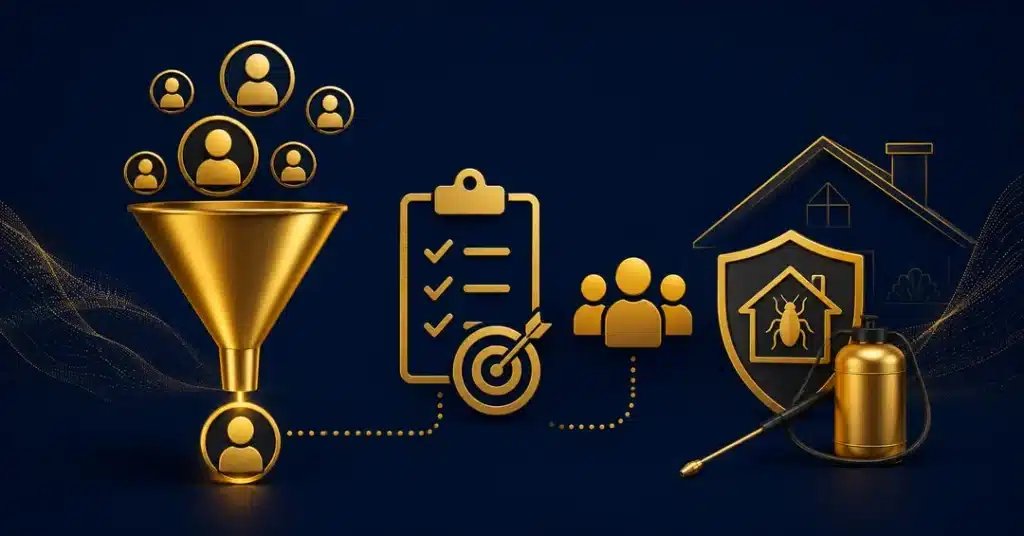
Why Lead Generation is the Lifeline of Your Pest Control Business?
Running a pest control business is hard work. You have trained technicians, quality chemicals, and the best equipment but without a steady flow of customers, none of it matters. In today’s digital-first world, waiting for referrals or relying on word-of-mouth alone is no longer enough. You need a smart, systematic approach to attract, capture, and convert potential customers into paying clients every single month. A professional Lead Generation Consultant can help build a predictable pipeline of qualified pest control leads.
Whether you are a small local pest control operator in a tier-2 city or a growing pest management company in a metro like Delhi, Mumbai, or Bengaluru lead generation is the engine that drives your revenue. This comprehensive guide will walk you through everything a pest control business owner genuinely wants to know before partnering with a digital marketing agency: strategy, platforms, planning, expected results, and the real cost of these services.
So, let’s get started.
Section 1: Understanding Lead Generation for Pest Control
1.1 What Is a Lead in the Pest Control Industry?
A lead is any potential customer who has shown interest in your pest control services. This could be someone who:
- Called your number after seeing a Google Ad
- Filled a contact form on your website
- Sent a WhatsApp message after seeing your Facebook post
- Clicked ‘Book Now’ on your Google Business Profile
Not all leads are equal. There are cold leads (people just browsing), warm leads (people researching options), and hot leads (people ready to book). A good lead generation strategy focuses on attracting high-intent, hot leads who are already looking for pest control services in your service area.
1.2 Why Pest Control Is a High-Demand, High-Competition Industry
Pest control is an essential service demand is constant throughout the year, with seasonal spikes during monsoons (termites, mosquitoes) and summer (cockroaches, rodents). The market is growing rapidly with increasing awareness about hygiene, especially post-COVID.
However, competition is fierce. In any city, there are dozens of local and national players all competing for the same customers online. This means that without a proper digital presence and lead generation strategy, your business will remain invisible even if your service quality is excellent.
Section 2: The Lead Generation Strategy Framework for Pest Control
2.1 The 4-Step ATTRACT–CAPTURE–NURTURE–CONVERT Framework
Every successful lead generation campaign for pest control follows this simple but powerful framework:
- ATTRACT: Use digital channels (Google, Facebook, Instagram, SEO) to reach people actively searching for pest control services in your area.
- CAPTURE: Drive them to a landing page or contact form where they leave their name, phone number, or email.
- NURTURE: Follow up with them via calls, WhatsApp messages, or emails to build trust and answer their questions.
- CONVERT: Close the deal by offering a compelling service package, discount, or free inspection.
2.2 Identifying Your Target Audience
Before launching any campaign, your marketing agency must help you define exactly who your ideal customer is. For pest control, this typically includes:
- Homeowners in residential apartments and independent houses
- Property managers and housing societies (RWAs)
- Restaurant and hotel owners (commercial pest control)
- Office building and warehouse managers
- Newly constructed building owners needing anti-termite treatment
Knowing your audience allows your agency to target the right demographics, geographies, and income groups avoiding wasted ad spend on people outside your service area or budget range.
2.3 Competitor Analysis and Market Positioning
Your agency should conduct a thorough competitor analysis to understand what other pest control companies in your area are doing online. This includes studying their Google Ads, their website content, their reviews, and their social media presence. Based on this research, a clear market positioning strategy is created defining your unique selling proposition (USP) such as same-day service, eco-friendly chemicals, government-certified technicians, or guaranteed results with a re-treatment policy.
Section 3: Step-by-Step Planning Before Launching Campaigns
3.1 Website Audit and Optimization
Before spending a single rupee on ads, your website must be ready to convert visitors into leads. A weak website will waste your entire advertising budget. Here is what needs to be in place:
- Fast Loading Speed (under 3 seconds): Mobile-Friendly Design
- Book Now, Call Us, Get Free Quote buttons on every page: Clear Call-to-Action (CTA)
- Separate pages for each service cockroach control, termite treatment, rodent control, mosquito control, bed bug treatment, etc.: Service Pages
- Separate pages targeting each city or area you serve: Location Pages
- Client testimonials, before-after photos, certifications, and service guarantees: Trust Signals
- Simple forms asking only for name, phone number, and service required: Lead Capture Forms
3.2 Google Business Profile Setup
If your business is not on Google Maps, you are missing out on a huge number of free, local leads every month. Your Google Business Profile (GBP) must be fully optimized with:
- Accurate business name, address, and phone number (NAP consistency)
- All service categories listed correctly
- High-quality before-after photos of your work
- Customer reviews actively requested and responded to
- Regular Google Posts with offers and seasonal promotions
3.3 Landing Page Creation
For paid advertising campaigns, generic website homepages do not work well. Your agency should create dedicated landing pages for each service or campaign for example, a separate landing page for ‘Termite Treatment in Delhi’ or ‘Cockroach Control in Pune.’ These pages are designed with a single focus: to get the visitor to submit their contact details or call your number.
3.4 Tracking and Analytics Setup
Before any campaign goes live, call tracking, conversion tracking, and Google Analytics must be properly installed. Without tracking, your agency cannot prove results or optimize campaigns. Key metrics to track include:
- Cost Per Lead (CPL)
- Lead-to-Booking Conversion Rate
- Which keywords and ads generate the most calls
- Geographic performance which areas generate the most leads
Section 4: Platforms Used for Pest Control Lead Generation
4.1 Google Search Ads (Pay-Per-Click)
Google Ads is the single most powerful platform for pest control lead generation. Why? Because when someone types ‘pest control near me’ or ‘termite treatment in [city],’ they are already looking to hire someone. These are hot, high-intent leads.
Your ads appear at the top of Google search results, above organic listings. You only pay when someone clicks on your ad. A well-managed Google Ads campaign for pest control typically delivers 30–80 leads per month depending on your city, budget, and service area. Working with an experienced PPC Consultant can help optimize campaigns, reduce cost per lead, and maximize ROI.
Key campaign types include:
- Search Campaigns: Text ads targeting specific keywords like ‘pest control service,’ ‘bed bug treatment,’ ‘cockroach control near me’
- Local Service Ads (LSA): Google-verified ads that appear above regular search ads with a ‘Google Guaranteed’ badge extremely powerful for pest control
- Call-Only Ads: Ads designed to generate direct phone calls, ideal for pest control where customers prefer to call
4.2 Facebook and Instagram Ads
While not as high-intent as Google Ads, Facebook and Instagram ads are highly effective for creating awareness, generating leads at a lower cost, and reaching customers who might need pest control but haven’t searched yet. These platforms are ideal for:
- Promoting seasonal offers (monsoon pest control packages, annual AMC plans)
- Retargeting website visitors who didn’t book
- Generating leads from residential housing societies and apartments
- Running lead generation forms directly within Facebook/Instagram (no website needed)
Facebook Lead Ads are particularly powerful for pest control a potential customer sees your ad, clicks it, and their name and phone number are auto-filled. Your team then calls them within minutes.
4.3 Search Engine Optimization (SEO)
SEO is a long-term strategy that generates free, organic leads from Google search without paying for each click. It takes 3–6 months to show results, but once rankings are established, leads come in consistently with no ongoing ad spend.
For pest control, SEO focuses on:
- Ranking for local keywords like ‘pest control in [city name],’ ‘best termite treatment [area]’
- Creating informative blog content (like this article) that attracts people researching pest problems
- Building local citations and backlinks from business directories
- Optimizing Google Business Profile for local map pack rankings
4.4 WhatsApp Marketing
India has over 500 million WhatsApp users. For pest control businesses, WhatsApp is a goldmine. A professional lead generation agency will set up a WhatsApp Business API account and use it to:
- Send promotional messages to opted-in lists of past customers and prospects
- Automatically reply to new inquiries with service details and pricing
- Send appointment reminders and follow-up messages
- Collect customer reviews after service completion
4.5 YouTube Ads
Short video ads on YouTube (6–15 seconds) are increasingly being used by pest control businesses to build brand awareness at very low costs. A short video showing your team professionally treating a home, along with a strong offer, can generate calls and form fills at a fraction of the cost of Google Search Ads.
4.6 Just Dial, Sulekha, and Local Business Directories
Platforms like Just Dial, Sulekha, and UrbanClap (Urban Company) are still heavily used in India for finding local service providers. Listing your pest control business on these platforms, keeping information updated, and collecting reviews can provide a steady stream of inbound leads especially in tier-2 and tier-3 cities.
Section 5: Expected Results What Should You Realistically Expect?
5.1 Short-Term Results (Month 1–3)
In the first one to three months, your agency will focus on setting up the foundation: website optimization, tracking, Google Business Profile, and launching initial paid campaigns. You can expect:
- 10–40 leads per month from Google Ads (depending on budget)
- 5–20 leads per month from Facebook/Instagram Ads
- Improved Google Maps visibility in your service areas
- Measurable data on which keywords, areas, and services drive the most leads
5.2 Medium-Term Results (Month 4–6)
With campaign data collected, your agency will optimize your ads for better performance reducing cost per lead and improving lead quality. You can expect:
- 20–70 leads per month from Google Ads
- 15–40 leads per month from Facebook/Instagram Ads
- First organic leads from SEO starting to trickle in
- Improvement in lead-to-booking conversion rate as follow-up systems are refined
5.3 Long-Term Results (Month 7–12)
By this stage, your digital presence is mature and working on multiple channels simultaneously. You can expect:
- 50–150+ leads per month from paid channels
- 30–60 organic leads per month from SEO and Google Business Profile
- A predictable, scalable lead generation system that grows with your business
Important Note: Lead volume depends heavily on your city size, service area coverage, budget, and the competitiveness of your local market. A pest control business in a large metro like Mumbai or Delhi will see higher volumes than a business in a smaller city. Your agency should give you realistic, location-specific projections not inflated promises.
Section 6: Cost of Lead Generation Services What Will You Pay?
6.1 Understanding Agency Service Charges
There are two separate costs involved in digital lead generation: the ad spend (the money you pay directly to Google, Facebook, etc.) and the agency fee (the money you pay your marketing agency for managing your campaigns). It is important to understand both clearly before signing any contract.
6.2 Typical Agency Pricing Models
Most digital marketing agencies for pest control use one of the following pricing models:
- Fixed Monthly Retainer: You pay a fixed fee every month for a defined set of services (campaign management, SEO, reporting, etc.). This is the most common and recommended model.
- Performance-Based (Cost Per Lead): You pay only for each verified lead delivered. This sounds attractive but often results in lower lead quality if not managed properly.
- Percentage of Ad Spend: Agency charges 15–25% of your total ad spend as their management fee.
6.3 Estimated Monthly Cost Breakdown
Below is a realistic cost breakdown for a pest control business running a comprehensive lead generation program in India:
| Service / Strategy | Estimated Monthly Cost (INR) | Expected Leads/Month |
| Google Ads Management | Rs. 5,000 – Rs. 20,000 | 20–60 Leads |
| Google Ads Spend (Budget) | Rs. 10,000 – Rs. 30,000 | Included Above |
| Facebook/Instagram Ads Mgmt | Rs. 5,000 – Rs. 20,000 | 15–40 Leads |
| Facebook/Instagram Ad Spend | Rs. 5,000 – Rs. 15,000 | Included Above |
| SEO (Local + On-Page) | Rs. 8,000 – Rs. 20,000 | 30–60 Leads (Month 6+) |
| Google Business Profile Opt. | Rs. 2,000 – Rs. 5,000 | 10–25 Leads |
| Landing Page Creation | Rs. 5,000 – Rs. 15,000 (one-time) | N/A |
| WhatsApp Marketing Setup | Rs. 3,000 – Rs. 8,000 | 5–15 Leads |
| Monthly Reporting & Strategy | Included in Retainer | N/A |
| TOTAL (Approx.) | Rs. 42,000 – Rs. 1,50,000/month | 80–200+ Leads |
Note: These are approximate figures. Actual costs will vary based on your city, target area, service scope, and competition level. A professional agency will give you a customized quote after an initial audit of your business and market.
6.4 What Questions Should You Ask Before Hiring an Agency?
Before signing with any lead generation agency, a smart pest control business owner should ask:
- Do you have experience working with pest control businesses specifically?
- Can you show me case studies or results from similar clients?
- How do you define and qualify a ‘lead’ just a form fill or a verified phone inquiry?
- What is the reporting frequency and what metrics will you share?
- What is the minimum contract duration and exit clause?
- Who owns the ad accounts, website, and data if we stop working together?
- How do you handle lead quality issues or months with low performance?
Section 7: Lead Follow-Up The Missing Piece Most Business Owners Ignore
7.1 Why Fast Follow-Up Is Critical
Here is an important truth that many pest control business owners do not realize: a lead is only as valuable as your follow-up speed. Research shows that calling a new lead within 5 minutes increases conversion rates by over 21 times compared to calling after 30 minutes. In the pest control industry, a customer who submits a form or calls is often comparing 3–5 companies simultaneously. The first company to respond professionally and offer a clear quote wins the business.
7.2 Building a Simple Lead Follow-Up System
- Immediate Acknowledgment: Send an automatic WhatsApp or SMS confirming you received their inquiry
- Call Within 5–10 Minutes: Train your team to call every new lead within 10 minutes during business hours
- Offer a Free Inspection: Reduce the barrier to entry by offering a free on-site inspection or phone consultation
- Follow Up Twice if No Response: Many customers are busy a polite follow-up call or WhatsApp message the next day can convert cold leads into bookings
- Track All Leads in a CRM: Use a simple CRM or even a Google Sheet to track every lead, their status, and follow-up history
Section 8: Key Performance Indicators (KPIs) to Track Monthly
Your agency should provide you with a clear monthly report covering these key metrics:
- Total Leads Generated (by channel Google, Facebook, Organic, WhatsApp, etc.)
- Cost Per Lead (CPL) Total spend divided by total leads
- Lead-to-Booking Conversion Rate What % of leads became paying customers
- Cost Per Acquisition (CPA) Total spend divided by total bookings
- Return on Ad Spend (ROAS) Revenue generated vs. total money spent
- Google Ads Quality Score and Click-Through Rate (CTR)
- Website Traffic and Bounce Rate
- Google Business Profile Views, Calls, and Direction Requests
A good agency will explain these numbers clearly, identify what is working and what is not, and present a plan for the following month based on data not guesswork.
Section 9: Common Mistakes Pest Control Business Owners Make with Lead Generation
- Choosing an Agency Based Only on Price: The cheapest agency is rarely the best. Focus on proven results and transparent communication.
- Running Ads Without a Proper Website or Landing Page: Sending paid traffic to a poor website is like pouring water into a leaky bucket.
- Ignoring Google Business Profile: This is one of the highest ROI activities for local pest control businesses and it costs nothing to set up properly.
- Not Following Up on Leads Quickly: Generating leads and not following up is the most expensive mistake a business owner can make.
- Expecting Overnight Results from SEO: SEO is a long game. Do not hire an agency and then cancel after 2 months because you do not see results yet.
- Not Tracking Conversions: If you do not know which campaigns are generating leads, you cannot optimize your spending intelligently.
Conclusion: Your Path to a Predictable Lead Generation System
Lead generation for pest control is not a mystery. It is a science one that, when executed with the right strategy, the right platforms, and the right agency partner, can transform your business from an unpredictable revenue cycle into a consistent, growing operation with a steady pipeline of new customers every month.
The key is to start with a solid foundation (website, tracking, Google Business Profile), invest in the right paid channels (Google Ads first, then Facebook), build long-term organic visibility through SEO, and ensure your team follows up on every single lead promptly and professionally.
Whether you are just starting out or scaling an established pest control business, the right digital marketing strategy will multiply your growth many times over. Do not wait for customers to find you go where they are, and make it easy for them to choose you.
About the Author
Lead Generation Expert & Digital Marketing Consultant
Helping Businesses Grow with Data-Driven Digital Strategies
Are you a pest control business owner struggling to get consistent leads every month? Gaurav Dubey is India’s trusted Lead Generation Expert and Digital Marketing Consultant with a proven track record of helping service businesses including pest control companies, home services brands, and facility management firms build powerful digital lead pipelines that deliver real, measurable results.
Gaurav specializes in end-to-end lead generation solutions including Google Ads, Facebook Ads, SEO, WhatsApp Marketing, and Conversion Rate Optimization. With deep expertise in the pest control and home services industry, he understands the unique challenges of local competition, seasonal demand, and customer acquisition costs.
What Gaurav Brings to Your Pest Control Business:
- Customized lead generation strategies tailored specifically for pest control and related service businesses
- Transparent, data-driven reporting you always know exactly where your money is going and what results it is producing
- Deep expertise in high-intent Google Ads campaigns that attract ready-to-book customers
- Proven Facebook and Instagram lead generation funnels designed for residential and commercial pest control
- Local SEO strategies that make your business rank #1 on Google Maps in your service areas
- WhatsApp marketing automation to maximize conversions from every lead generated
- End-to-end campaign management from setup and strategy to optimization and reporting
Gaurav has worked with pest control companies across Delhi, NCR, Mumbai, Pune, Bengaluru, Hyderabad, and multiple tier-2 cities, helping them scale from inconsistent lead flows to 100 – 200+ verified leads every month with a clear Return on Investment.
If you are tired of spending money on marketing without seeing predictable results, it is time to work with a specialist who understands your industry.