
Digital advertising has become one of the most important growth channels for hair transplant clinics. Patients today rarely walk into a clinic without doing their homework first. They research clinics online, compare treatments, read reviews, look at before-and-after results, and check pricing before ever picking up the phone. Because of this shift in behavior, the question of Google Ads vs Meta Ads for Hair Transplant Clinics has become one of the most common decisions clinic owners and marketing teams face when planning their advertising budget.
Both platforms can generate valuable enquiries, but they work in very different ways. Understanding these differences is essential before investing time and money into either one. This article breaks down how each platform functions, where each one performs best, and how a well-planned lead generation strategy can use both together for stronger results.
Google Ads is a search-based advertising platform. It shows ads to people who are actively typing queries into Google, which means it captures demand at the moment someone is already looking for information. Meta Ads, which covers Facebook and Instagram, works differently. Instead of relying on search intent, it uses interest-based and behavioural targeting to show ads to people who may not be searching yet but could still be a good fit based on their profile, interests, and online activity. This fundamental difference in how each platform reaches people is the foundation for understanding Google Ads vs Meta Ads for Hair Transplant Clinics.
Google Ads vs Meta Ads for Hair Transplant Clinics: Which Is Better?
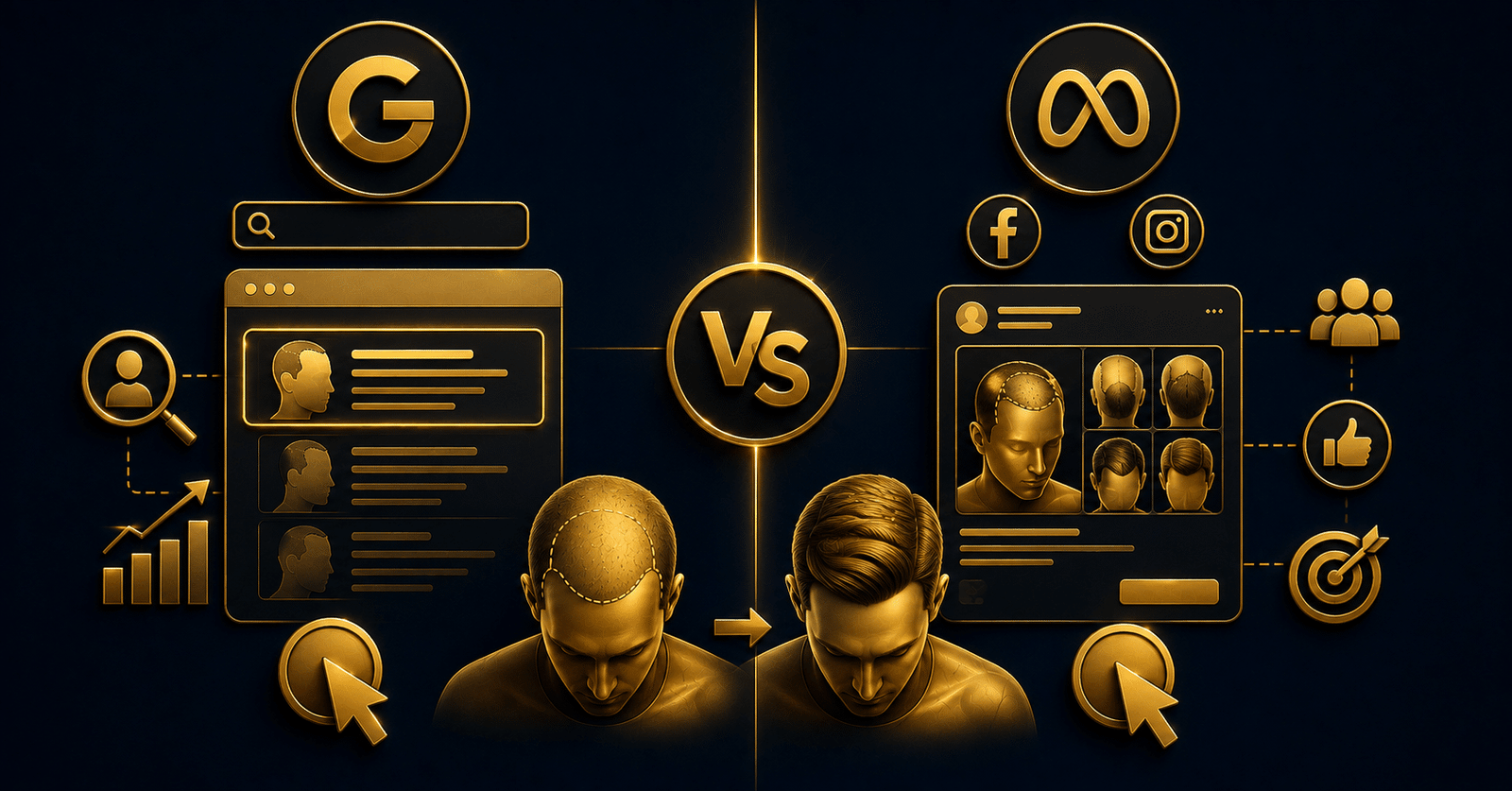
There is no single answer to which platform is “better” because they serve different purposes within the patient journey. Google Ads generally captures users who already have active search intent. Someone searching for hair restoration options, comparing clinics, or looking up treatment information is showing a clear signal of interest, and Google Ads places a clinic directly in front of that demand.
Meta Ads, on the other hand, is better suited for creating awareness, generating interest, and showcasing visual content to audiences who may not yet know they need a consultation. Because Meta Ads relies on engaging visuals, educational videos, and relatable content, it can introduce a clinic’s brand to potential patients earlier in their decision-making process, well before they start actively searching.
In short, Google Ads tends to work well for capturing existing demand, while Meta Ads tends to work well for building demand and nurturing interest over time. Many clinics find that combining both, supported by strong PPC services and Social media services, produces more consistent and higher-quality enquiries than relying on just one channel.
Google Ads for Hair Transplant Clinics
Google Ads operates primarily through Search Ads, which appear when someone types a relevant query into the search bar. For hair transplant clinics, this could include searches related to treatment options, clinic locations, procedure types, or general information-seeking queries. Because these ads are shown in response to a real search, they tend to reach people who already have a specific need in mind.
Keyword targeting is at the core of any Google Ads campaign. Choosing the right mix of keywords, and just as importantly, using negative keywords to filter out irrelevant traffic, helps ensure that the budget is spent on people who are genuinely likely to be interested. Search intent varies widely. Some users are simply researching information, while others are closer to making a decision and are actively comparing clinics. Recognising these different levels of intent allows a clinic to structure campaigns more effectively and avoid wasting spend on searches that are unlikely to convert.
Location targeting is another important feature, since hair transplant clinics typically serve patients within a specific city, region, or travel radius. Combining strong location targeting with high-intent searches helps concentrate the advertising budget where it is most likely to generate genuine enquiries.
Ad copy plays a significant role in performance. Clear, honest messaging that avoids exaggerated claims tends to build more trust with potential patients than ads that make bold promises. This ties directly into the landing pages that ads point to. A well-designed landing page should load quickly, present information clearly, and make it easy for a visitor to take the next step, whether that is filling out a form or calling the clinic.
Call tracking and conversion tracking are essential for understanding what is actually working. Without proper tracking, it becomes very difficult to know which keywords, ads, or landing pages are producing real enquiries versus which ones are simply generating clicks. Remarketing also plays a role here, allowing a clinic to stay visible to people who visited the website but did not convert on their first visit. Ongoing campaign optimization, guided by data rather than guesswork, is what separates a well-run Google Ads account from one that simply spends money without a clear return.
It is worth noting that hair transplant clinics must follow applicable advertising policies set by Google, particularly around medical and healthcare-related advertising. Ads should avoid misleading claims, exaggerated before-and-after promises, or guarantees about outcomes. Staying compliant not only protects the account from being suspended but also builds long-term trust with potential patients. Many clinics choose to work with providers offering dedicated PPC services to manage these requirements correctly while keeping campaigns effective.
Meta Ads for Hair Transplant Clinics
Meta Ads covers advertising across Facebook and Instagram, two platforms that are heavily visual and driven by engagement rather than direct search queries. For hair transplant clinics, this creates an opportunity to use compelling visual creatives, educational videos, and behind-the-scenes clinic content to introduce the brand to a wider audience.
Unlike Google Ads, where users are actively searching, Meta Ads reaches people while they are browsing their feed, often without any immediate intent to look into hair restoration services. This makes creative quality especially important. Videos that explain the treatment process, content that shows the clinic environment, and testimonials shared where permitted by platform policy can all help build familiarity and trust before a person is ready to reach out.
Before-and-after content, where compliant with advertising guidelines, can also be effective on Meta, since visual proof tends to resonate strongly with audiences browsing image and video-based platforms. However, clinics need to be careful to follow Meta’s advertising policies regarding health and medical content, avoiding exaggerated claims or misleading visual comparisons.
Audience targeting on Meta allows clinics to reach people based on interests, demographics, and behaviours rather than search terms. This is particularly useful for reaching people who may be considering hair restoration but have not yet started actively researching it. Retargeting is another strong feature, allowing clinics to re-engage people who previously interacted with their content, visited their website, or submitted partial information through a lead form.
Lead forms native to the Meta platform can reduce friction by allowing potential patients to submit their details without leaving the app, while website campaigns can drive traffic to a dedicated landing page for more detailed information. Both approaches have their place depending on campaign goals. Well-managed Meta Ads services typically combine both formats to test what performs best for a specific clinic and audience.
Social media services also play a supporting role beyond paid campaigns. Organic content, community engagement, and consistent posting help build trust and credibility, which can improve how paid ads are received. When organic and paid social media work together, potential patients are more likely to recognise and trust a clinic’s brand by the time they see a paid ad.
Google Ads vs Meta Ads: Key Differences for Hair Transplant Clinics
To make the comparison clearer, it helps to look at how the two platforms differ across several important factors relevant to hair transplant clinics.
- User Intent: Google Ads captures active search intent because users are already searching for specific services. Meta Ads, on the other hand, mainly builds awareness and creates interest among users who may not be actively searching.
- Audience Targeting: Google Ads primarily uses keywords, location, demographics, and search intent for targeting. Meta Ads offers detailed targeting based on interests, behaviours, demographics, and online activity.
- Advertising Format: Google Ads commonly uses text-based search ads that appear when users search for relevant terms. Meta Ads focuses more on visual formats such as images, videos, carousels, Stories, and Reels.
- Speed of Results: Google Ads can often generate faster results when targeting high-intent keywords. Meta Ads may take more time to convert users because it often works by building awareness and interest first.
- Creative Requirements: Google Ads generally requires strong ad copy and relevant landing pages. Meta Ads usually needs more creative content, including attractive images, videos, and engaging captions.
- Retargeting: Both platforms support retargeting. Google Ads can retarget users through search and display campaigns, while Meta Ads offers strong retargeting through feeds, Stories, Reels, and other placements.
- Cost Considerations: Google Ads costs depend heavily on keyword competition, location, and bidding. Meta Ads costs are influenced by factors such as audience size, competition, engagement, and ad quality.
- Suitable Objectives: Google Ads is often suitable for direct enquiries, appointment bookings, and users with strong purchase intent. Meta Ads is particularly useful for building awareness, generating interest, engaging audiences, and nurturing potential customers.
User intent is perhaps the clearest distinguishing factor. Google Ads meets people at the moment they are actively searching, while Meta Ads introduces a clinic to people who may not have started searching yet. Audience targeting also differs significantly, with Google relying on keywords and Meta relying on interests and behaviours.
The advertising format itself is another key difference. Google Ads is largely text-based, appearing within search results, while Meta Ads is built around visual storytelling through images, videos, and carousel formats. This means the creative demands for Meta Ads are generally higher, requiring investment in quality visuals and video production.
Speed of results can also vary. Because Google Ads targets people already searching, it can often generate enquiries more quickly. Meta Ads may take longer to convert since it is working with a colder audience, but it can produce strong results over time as awareness builds. Retargeting is valuable on both platforms, though it tends to feel more natural within Meta’s feed and stories format.
Cost considerations depend heavily on the clinic’s location, competition level, and campaign objectives, so it is difficult to say definitively which platform is cheaper without testing both. Ultimately, the suitable campaign objective should guide the decision. If the goal is to capture people who are ready to enquire, Google Ads may be the priority. If the goal is to build long-term brand awareness and nurture interest, Meta Ads may deserve a larger share of the budget.
Google Ads may be more suitable when a clinic wants to capture existing demand from people actively researching treatments in their area, especially in competitive markets where search volume is high. Meta Ads may be more suitable when a clinic wants to build brand awareness, showcase its expertise through video content, or reach a broader audience that may convert over a longer timeline. There is no universal winner in the Google Ads vs Meta Ads for Hair Transplant Clinics debate. The right platform, or combination of platforms, depends on the clinic’s target audience, location, budget, range of services, level of local competition, sales process, and overall marketing objectives.
Using Google Ads and Meta Ads Together for Better Lead Generation
Rather than viewing this as a choice between one platform or the other, many successful clinics use both as part of an integrated lead generation strategy. A typical patient journey might begin with Meta Ads, where a person sees an educational video or clinic content while scrolling their feed. This builds initial awareness, even if the person does not take action immediately.
Later, when that same person decides to look further into their options, they may turn to Google to search for more specific information or compare local clinics. At this stage, Google Ads can capture that high-intent search and guide them toward a dedicated landing page. If they still do not convert on that visit, remarketing across both platforms can bring them back, reinforcing the clinic’s messaging until they are ready to take the next step.
This kind of integrated approach combines paid search, paid social, landing pages, remarketing, and structured follow-up into a cohesive system rather than treating each channel in isolation. When these pieces work together, clinics often see more consistent enquiry flow compared to relying on a single channel alone.
Lead Generation Services, Landing Pages, and Follow-Up

Strong Lead Generation services go beyond simply running ads. Landing-page optimization plays a critical role, since even the best-targeted ad will underperform if it sends traffic to a slow, confusing, or poorly designed page. A good landing page should clearly explain what the clinic offers, build trust through clear information, and make the next step obvious, whether that is booking a consultation or submitting an enquiry form.
Lead qualification is equally important. Instead of focusing purely on the number of enquiries received, clinics benefit more from focusing on lead quality. This means looking at qualifying factors such as genuine treatment interest, location relevance, willingness to attend a consultation, and overall intent, without making inappropriate assumptions about any individual’s medical situation. Conversion tracking ties this all together by showing which campaigns, keywords, or creatives are actually producing enquiries that turn into consultations, rather than just clicks.
Follow-up processes matter just as much as the advertising itself. A well-generated lead can be lost if follow-up is slow or inconsistent. Clinics that pair strong advertising with a responsive follow-up system tend to convert a higher percentage of their enquiries into booked consultations.
The Role of SEO in Hair Transplant Clinic Lead Generation
While paid advertising can generate faster results, SEO Services provide long-term organic visibility that continues to work even when ad spend is paused. Ranking well in organic search results builds credibility, since many users trust organic listings alongside paid ads when researching a clinic.
Technical SEO forms the foundation of this visibility. This includes website speed, mobile-friendliness, crawlability, indexability, clear site structure, thoughtful internal linking, accurate metadata, and an overall smooth user experience. A website that loads slowly or is difficult to navigate on mobile devices can hurt both organic rankings and the performance of paid campaigns, since landing pages built on the same site often share the same technical foundation.
Rather than treating SEO and paid advertising as competing strategies, the most effective approach treats them as complementary. Paid ads can generate quicker visibility while SEO builds a sustainable presence over time. A clinic that invests in both is less dependent on any single channel and tends to build a more resilient lead generation system overall.
How a Digital Marketing Consultant Can Help
Planning, launching, and optimizing campaigns across Google Ads and Meta Ads requires ongoing attention. A Digital Marketing Company, Digital Marketing Consultant, PPC Consultant, or Lead Generation Consultant can support a clinic through campaign strategy, audience research, keyword research, ad creative development, landing page design, tracking setup, reporting, testing, and ongoing optimization.
This kind of support typically includes analysing lead quality over time, not just enquiry volume, so that campaigns can be refined to attract more relevant potential patients. It is important to note that no responsible consultant should promise guaranteed leads, guaranteed patients, guaranteed return on investment, or guaranteed medical outcomes. Digital advertising can improve visibility and generate opportunities, but outcomes depend on many factors including market conditions, competition, and how well a clinic manages its own follow-up and consultation process.
Common Mistakes Hair Transplant Clinics Should Avoid in Google Ads and Meta Ads
A number of common mistakes can quietly drain advertising budgets without producing meaningful results. Broad targeting is one of the most frequent issues, where campaigns are set up to reach too wide an audience without enough focus on location or relevant interests, leading to wasted spend on people unlikely to convert. Weak ad messaging is another common problem. Ads that fail to clearly communicate what makes a clinic worth considering often get overlooked, regardless of how much budget is behind them.
Poor landing pages can undo the value of even a well-targeted campaign. If a page takes too long to load, is difficult to navigate, or does not clearly guide the visitor toward the next step, much of the advertising investment goes to waste. A related issue is the lack of proper conversion tracking, which leaves clinics unable to identify which campaigns or keywords are actually generating enquiries versus which ones are simply consuming budget.
Irrelevant keywords and ignoring negative keywords are particularly costly mistakes within Google Ads specifically, since they can cause a campaign to show up for searches that have little to do with what the clinic actually offers. On the Meta Ads side, poor-quality creatives, such as low-resolution images or unclear videos, tend to underperform significantly compared to well-produced visual content. Slow follow-up after a lead comes in is another mistake that affects both platforms equally, since even a well-qualified lead can lose interest if there is a delay in response. Finally, focusing only on generating cheap leads, rather than genuinely qualified ones, and failing to test different ad variations over time, are mistakes that limit long-term campaign improvement.
Choosing the Right Digital Marketing Consultant for Hair Transplant Clinics

When evaluating a Lead Generation Consultant, PPC Consultant, or Digital Marketing Consultant, clinics should consider several factors beyond general marketing experience. Relevant experience working specifically with healthcare or clinic-based businesses can be valuable, since these industries often have specific advertising policies and compliance considerations to navigate.
A solid understanding of both Google Ads and Meta Ads, along with practical experience delivering PPC services and Social media services, is important for building campaigns that reach the right audience through the right channel. Knowledge of SEO Services and technical SEO is also valuable, since a consultant who understands both paid and organic channels can build a more complete strategy rather than focusing on one in isolation.
Beyond platform knowledge, clinics should look for a consultant who prioritises proper conversion tracking, thoughtful landing-page strategy, and transparent reporting that clearly shows what is working and what needs adjustment. Ongoing campaign optimization, rather than a set-and-forget approach, is a sign of a consultant who is genuinely invested in improving results over time rather than simply maintaining existing campaigns.
Frequently Asked Questions (FAQs)
- What is the main difference between Google Ads and Meta Ads for hair transplant clinics?
The main difference lies in intent. Google Ads shows ads to people actively searching for information, meaning it captures existing demand at the moment someone is looking for answers. Meta Ads, covering Facebook and Instagram, reaches people based on interests and behaviours rather than search activity, which means it often introduces a clinic to potential patients before they start actively searching. Both approaches have value within a broader lead generation strategy, and many clinics use them together rather than relying on just one platform to cover the entire patient journey from awareness to enquiry.
- Which platform generates faster results, Google Ads or Meta Ads?
Google Ads often produces faster results because it targets people who are already searching with clear intent, meaning the audience is closer to making a decision. Meta Ads can take longer to convert since it typically reaches a colder audience that has not yet expressed direct interest. However, Meta Ads can be effective for building awareness over time, which may lead to conversions later, sometimes even through a subsequent Google search. Combining both through well-managed PPC services often produces more balanced results across different stages of the patient journey.
- How does Google Ads target people searching for hair transplant information?
Google Ads relies on keyword targeting, matching ads to relevant search queries typed by users. Clinics can also apply location targeting to focus on their service area and use negative keywords to filter out irrelevant searches. This combination helps ensure that ad spend is concentrated on people genuinely interested in hair restoration services within a specific region. Search intent can vary from general research to more decision-focused queries, and understanding these different intent levels helps clinics structure campaigns more effectively through thoughtful campaign optimization and ongoing keyword refinement.
- How does Meta Ads help with retargeting potential patients?
Meta Ads allows clinics to retarget people who have previously interacted with their website, videos, or lead forms. This means someone who visited a landing page but did not submit an enquiry can be shown follow-up ads later, reinforcing the clinic’s messaging. Retargeting through Meta tends to feel natural since it appears within a person’s regular feed or stories. This approach works well alongside remarketing strategies used in Google Ads, creating multiple touchpoints that can gently guide interested users back toward taking action.
- Are Google Ads or Meta Ads more expensive for hair transplant clinics?
Cost depends on several factors, including location, competition level, audience size, and campaign objectives, so there is no fixed answer regarding which platform is cheaper. Google Ads costs are influenced by keyword competition, while Meta Ads costs depend more on audience size and engagement levels. Rather than comparing cost in isolation, clinics should evaluate cost alongside lead quality and conversion rates. A PPC Consultant can help analyse performance data from both platforms to determine which one delivers better value for a specific clinic’s goals and budget.
- Can SEO replace the need for Google Ads or Meta Ads?
SEO and paid advertising serve different purposes and work best together rather than as replacements for one another. SEO Services, supported by strong technical SEO, build long-term organic visibility that continues working even without ongoing ad spend. However, SEO typically takes longer to show results compared to paid campaigns. Google Ads and Meta Ads can generate quicker visibility and enquiries while organic rankings develop over time. Clinics that invest in both tend to build a more sustainable and resilient online presence rather than depending entirely on one channel.
- How can hair transplant clinics improve lead quality from their ad campaigns?
Improving lead quality involves more than just increasing ad spend. Clinics should focus on precise audience targeting, clear ad messaging, and well-optimized landing pages that set accurate expectations. Proper conversion tracking helps identify which campaigns produce genuinely interested enquiries rather than just clicks. Lead qualification, based on factors like location relevance and genuine treatment interest, also plays a role. Working with a Lead Generation Consultant who understands both PPC services and Social media services can help refine targeting and messaging to attract more relevant potential patients over time.
- Should hair transplant clinics use Google Ads and Meta Ads together?
Yes, many clinics benefit from using both platforms as part of an integrated lead generation strategy. A typical journey might involve Meta Ads building initial awareness through visual content, followed later by a Google search when the person is ready to look further into their options. Google Ads can then capture that high-intent search, while remarketing across both platforms helps bring back people who have not yet converted. This combined approach, supported by strong PPC services and Meta Ads services, often produces more consistent results than relying on a single channel alone.
- What role does landing page design play in Google Ads and Meta Ads performance?
Landing page design has a significant impact on how well ad campaigns convert. A page that loads quickly, presents information clearly, and makes the next step obvious tends to perform better than a slow or confusing one, regardless of how well-targeted the ad itself is. Landing-page optimization should align with the messaging used in the ad to create a consistent experience. Poor landing pages can undermine strong advertising, which is why clinics working with a Digital Marketing Consultant often review landing page performance alongside campaign-level advertising data.
- How do I choose the right consultant to manage Google Ads and Meta Ads for my clinic?
When choosing a Digital Marketing Consultant, PPC Consultant, or Lead Generation Consultant, clinics should look for relevant experience with paid advertising platforms, a clear understanding of Google Ads and Meta Ads, and familiarity with SEO Services and technical SEO. Transparent reporting, proper conversion tracking, and a focus on ongoing campaign optimization are also important indicators of a capable consultant. It is worth being cautious of anyone who guarantees a specific number of leads or patients, since genuine results depend on multiple factors beyond advertising alone, including the clinic’s own follow-up process.
Conclusion
The debate around Google Ads vs Meta Ads for Hair Transplant Clinics does not have a one-size-fits-all answer. Google Ads excels at capturing people who are already searching with clear intent, making it a strong choice for clinics looking to generate direct enquiries from people actively comparing options. Meta Ads excels at building awareness, showcasing visual content, and nurturing interest among people who may not yet be actively searching but could become potential patients over time.
Rather than choosing one over the other, many clinics find greater success by using both platforms together as part of a broader lead generation strategy, supported by strong PPC services, Meta Ads services, Social media services, and long-term SEO Services including technical SEO. Working with an experienced Digital Marketing Company or Digital Marketing Consultant can help a clinic navigate these decisions, test different approaches, and refine campaigns based on real performance data rather than guesswork. The right mix ultimately depends on the clinic’s specific goals, audience, budget, and competitive landscape.